#15 the French “r”. Many people think this uniquely French sound is hard to make and sounds harsh, but in reality it is very soft and quite easy to learn.
10 Funniest French Onomatopoeia - Written Sound

This informative article shared from French Today is especially appropriate for the PronouncingFrench website since we specialize in sounds. This fun blog gives the sounds that the French language uses to imitate real sounds, or onomatopoeia (maybe you remember that term from poetry units in your English classes.) So whereas in English we say “shhhh” for “be quiet”, the French say “chut”. The last entry also offers a charming video of a mother and her baby to illustrate the word for “cooing”.
"HARD WORDS IN FRENCH" #14
Hard Words #14
This is a word you see in airports and train stations, welcoming visitors, so it's a good idea to know how to say it. It does feature a French vowel that we don't have in English and that many find challenging to say. I give a hint about how French speakers form this sound which is also the sound you have in “soeur” or “oeuf”.
Experience France with Geri: The Orsay Museum

Le Musée d'Orsay gets my vote as one of the most enjoyable places in Paris to spend a few hours. Although most people go to enjoy the beloved Impressionists, I want to take you on a visit to the building itself which has so many stunning points of beauty. I recommend you start your visit in the morning hours soon after opening.

This building was once a railroad station from the 19th century, so as you walk down the center aisle after entering, look up and around at the iron work from the original station, and above all, turn around to admire the beautiful clock over the entrance. Since this article features the building, I will deliberately try to walk you along without mentioning the art works you will stop and see along the route. But as you go down the central hallway, the pre-Impressionists are in little rooms to your left, and dramatic sculptures line the pathway. At the end of the first floor you can walk on a glass floor to look down on a model of 19th century Paris featuring the Opéra and surrounding streets. To the left of this exhibit there is an escalator which takes you up to the Impressionist collection.

Follow the signs “Suite de l'Impressionisme.” Once on the next level, across from the gift shop, don't miss the famous and massive clock on the outside of the building. This is a super photo spot: the shot through the hands of the clock reveals Sacré-Coeur high on the top of Montmartre. From here you will follow the galleries showing the art of the most famous 19th century Impressionist painters and at the end of the galleries there is a tea room. I recommend eating lunch later on in your visit at another spot in the museum, but you should enter the tearoom where there is an exit onto the roof with a fabulous view over Paris. Continue along past the works of Van Gogh, Gauguin and Seurat, and find the room with the pastels of Toulouse-Lautrec, in dim light to protect the colors. As you exit this room you will be in front of a stairway.
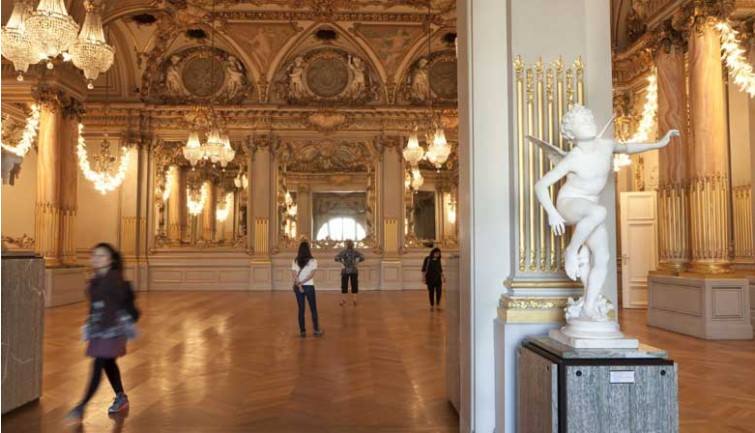
Go down three flights of stairs, turn left and walk along the hallway to an elegant room on the right called “La Salle des Fêtes”. This was a room in the hotel which adjoined the Orsay railway station, and carries us back to another time of opulence with its crystal chandeliers and lovely statues.
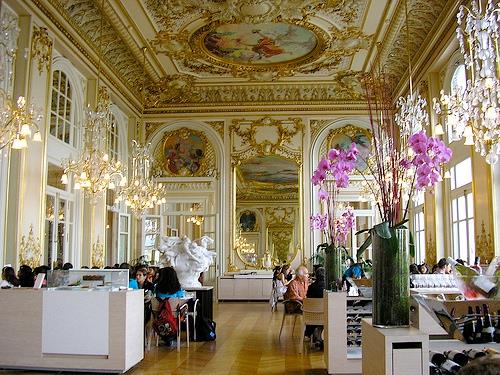
And finally, go back out of this room and retrace your steps, turning right and following signs to the restaurant where I recommend having your lunch. This is another beautiful room in the style of the period, and it is a real treat to dine in this elegant ambiance. As a P.S., it's good if you can plan it, to visit the Rodin Museum just after your Orsay visit, since both museums are open on Tuesday when all the other French museums are closed. Here you can find an outdoor café for lunch or refreshments. The Rodin is an easy walk from the Orsay.
HARD WORDS IN FRENCH #13
#13 "serrurerie" This one is the hardest word that expats listed as most difficult in an article from TheLocal.fr, “10 hardest words in French”. In our series “Hard Words” we have covered them all (lesson 2-13). And “serrurerie” really is a challenge to pronounce. All those r's! In this lesson you will learn the secret to overcoming the difficulties of this pesky word as we break it down and make it a bit more pronounceable!
Who doesn't love a baguette?

This article, written from an expat's point of view says that any difficulties around moving to France are worth it when you consider the food! Even the flour is special for baguettes, which is why I often am disappointed in versions made here in the U.S. So take a look at this interesting blog and let your mouth water. And while you are on the website, check out under “courses” to learn more about my video course which will have you speaking like the French, so when you do go into that boulangerie for your morning baguette or croissant, you will sound like a local. Bon appétit!
READ THE ARTICLE HERE
"HARD WORDS IN FRENCH" #12
bouilloire The expats in France listed bouilloire as one of their “10 hardest words in French” and it's an important word, meaning tea kettle. As in most of these words, it is the spelling that causes the concern, especially the combination “ill” which has appeared in most of the words in this series. We saw this in the last word, #11, grenouille. It is really easy to say: the same sound you have in “bien” or “Pierre” or as in “yes” in English. To improve the quality of your spoken French, you will benefit from my video course. Check our more information on the website under courses.
Paris Shops are Marking their Windows for the Homeless

Once again we see a compassion in the French that often seems to be absent here at home. The cultural norm in France, and in Europe in general is to reach out to the least advantaged in their society. What a generous gesture to offer basic services to the homeless—of which there are more and more both in the U.S. and abroad. Let's hold the space that as a culture we can develop facilities in our cities and towns to help those who are not in a position to help themselves for the moment. Let's hear it for love!
CLICK HERE TO READ THE ARTICLE
11 Things You Didn’t Know About the French Language

You might already be familiar with some of the data in this informative little article about the French language, but I'll bet you didn't realize that the name of “the one who cannot be named” from the Harry Potter books is actually French: Voldemort (vol de mort) It seems that J.K. Rowling is a student of French! You will also hear again that France is the #1 tourist destination, and have another reminder of the rigor and discipline required of French students: the only country in Europe where philosophy is part of the high school curriculum. Of course in U.S. high schools …. And you will learn all the places in the world where you can communicate in French plus the origin of that annoying quatre-vingt-quatorze.
CLICK HERE TO READ THE ARTICLE
Paris rooftops with gardens!

Often just the smallest change can have a huge effect on our environment and our well-being. Once again, a European country—in this case our beloved France—has initiated a program requiring rooftop gardens or solar on all new commercial buildings. This is a direction we need to be going in the U.S. also. Gardens not only attract bees but they provide food and beauty to the beholder. Let's find ways to bring these good ideas into fruition in our own lives. Here's to life!
CLICK HERE FOR THE FULL ARTICLE
HARD WORDS IN FRENCH #11
Hard words #11
Our word this time is the fun word for “frog”: grenouille. You will often see this on menus in French restaurants as “cuisse de grenouille” or frog's legs, so it's a good idea to know how to say it correctly. The second syllable is the same as the word for “noodle”, nouille. And once again, as in most of these hard words listed by expats, there is that “ill” combination which seems hard to say but is really just one sound, the semi-vowel “iyuh” as in il y a. In my video course, you learn how to say each French sound as well as how the French produce those sounds through what I call “the French mouth”. Find more information on the website under courses.